ANZIC Governing Council are pleased to announce that they will be offering a maximum $3K AUD/NZD travel bursaries to attend IODP Workshops in 2020. Support will be made available to successful Australian & New Zealand applicants approved to attend workshop by organisers. ANZIC will select applicants based on the basis of ANZIC Science Committee ranking of applications.
The ANZIC Ocean Planet Workshop report, “Ocean Planet: An ANZIC workshop report focused on future research challenges and opportunities for collaborative international scientific ocean drilling” is now available for viewing and download. The report forms part of the future international Science Strategic Plan beyond 2023.
Jackson Mccaffrey a University of Melbourne PhD student (supervised by A/Prof Stephen Gallagher and A/Porf Malcolm Wallace) has used detailed subsea seismic data and information from cores obtained from IODP Expedition 356 to discover an ancient great barrier reef off Australia’s coast.
Our research shows that a 2000 km long reef similar to the present east coast Great Barrier Reef persisted and expanded for millions or years around 15 million years ago off North West Australia and pretty much disappeared by 10 million years ago.
Nevertheless, the modern “less great” remnants of this reef are still present today as smaller patches off the Kimberley coast, the Rowley Shoals, Ningaloo Reef and the Houtman-Abrolhos reefs.
What could have led to the death of the North West Australian Great Barrier Reef?
We suggest that a combination of ocean/climate change and subsidence (the region started sinking at a very fast rate just prior to reef demise) caused the drowning of this huge feature, leaving a few small modern reefs today.
Special call for scientists with expertise in radiolarian micropaleontology, preferably with experience in the northwest Pacific region, to apply for Expedition 386. The deadline to apply for this special call is October 11, 2019 at 11:59 PM EDT.
IODP is now accepting applications for scientific participants on Expedition 386 Japan Trench Paleoseismology, aboard a Mission-Specific Platform (MSP) organised by the ECORD Science Operator (ESO) and jointly implemented with the Institute for Marine-Earth Exploration and Engineering (MarE3) within the Japan Agency for Marine-Earth Science and Technology (JAMSTEC). At this time, it is envisaged that the offshore phase of Exp. 386 will take place on the R/V Kaimei for up to 50 days in spring and/or summer of 2020 (Apr-Aug).
To learn more about the scientific objectives of this expedition please watch this informational webinar held on 20 June 2019 here. More detailed expedition information here.
Scientific ocean drilling is more than half a century old this
year. Discoveries from scientific ocean drilling through the DSDP, ODP and IODP
programs have helped reveal Earth’s history, and have been critical to shaping
our understanding of how our planet works. But despite the wealth of knowledge
gained though five decades of scientific ocean drilling, there remain many new scientific
challenges that directly impact our society and that can only be addressed with
future scientific ocean drilling.
Planning for a new science plan for the post-2023 era is
now underway. International planning workshops have been
held over the last year in India, Australia, Japan, Europe, and the United
States, to capture the opinions of these international science communities. Another
workshop will be held this month in China. By the end of this process, more
than 800 participants will have worked together to assess the continuing
relevance of the 2013-2023 science plan, and to explore possibilities for a new,
post-2023 science plan in support of future scientific ocean drilling. The highlights
and key outcomes of those planning workshops are now available.
In July 2019, eighteen international delegates comprising the Science
Plan Working Group (see below my signature) met to produce a Science
Plan Structure and Road Map document highlighting the
commonalities in the workshop outcomes and indicating a potential way
forward towards a new science plan. Key aspects of this proposed new science
plan, entitled Exploring Earth by Scientific Ocean Drilling, are:
A strong emphasis on interdisciplinary science at the
crosslinks between science themes;
Enabling the next generation in scientific ocean
drilling through a science plan that extends to 2050;
Eight open-ended strategic objectives that form the
core of the science plan;
Five long-term, interdisciplinary flagship initiatives
that address critical societal challenges;
Five-year programmatic reviews that allow intermediate
adjustment or additions.
This Science Plan Structure and Road Map document is now available for viewing. In January and March 2020 there will be two commenting cycles, when successive drafts of the future science plan will be made available to the community on the IODP.org website. As this is a new plan in support of the future generations of scientific ocean drilling researchers, we especially seek input from early- and mid-career scientists.
Thank you so much for your continued support and energy in
providing scientific ocean drilling with a bright future into the mid-21st
century!
Anthony Koppers, Chair
Instituting
Scientific Ocean Drilling Beyond 2023
on behalf of the Science Plan Working Group
Delegates (18)
of the Science Plan Working Group:
Anthony Koppers (Chair) Oregon
State University U.S.
Cristiano Chiessi University
of São Paulo Brazil
Gail Christeson University
of Texas at Austin U.S.
Mike Coffin University
of Tasmania Australia
(ANZIC)
Rosalind Coggon University
of Southampton U.K. (ECORD)
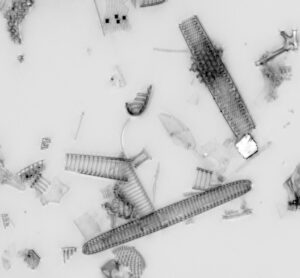
Diatom paleontologist Dr. Linda Armbrecht wants to use the past to understand how modern climate change might affect marine life. But the microfossils she looks at every day through the microscope are only one piece of the puzzle. To answer questions about how ocean ecosystems have changed over the last 12,000 years and beyond, she’s looking for something else in the mud: ancient DNA.
Diatom paleontologist Dr. Linda Armbrecht wants to use the past to understand how modern climate change might affect marine life. But the microfossils she looks at every day through the microscope are only one piece of the puzzle. To answer questions about how ocean ecosystems have changed over the last 12,000 years and beyond, she’s looking for something else in the mud: ancient DNA.Learn more about the science of Expedition 382 to Iceberg Alley aboard the JOIDES Resolution here: https://joidesresolution.org/expedition/382/Video by: Lee StevensMusic from https://filmmusic.io"Industrious Ferret" by Kevin MacLeod (https://incompetech.com)License: CC BY (http://creativecommons.org/licenses/by/4.0/)
Expedition Report: Creeping Gas Hydrate Slides. Proceedings of the International Ocean Discovery Program, 372A: College Station, TX (International Ocean Discovery Program). Published 5 May 2019. http://publications.iodp.org/proceedings/372A/372Atitle.html
Expedition Report: Hikurangi Subduction Margin Coring, Logging, and Observatories. Proceedings of the International Ocean Discovery Program, 372B/375: College Station, TX (International Ocean Discovery Program). Published 5 May 2019. http://publications.iodp.org/proceedings/372B_375/372B375title.html